
Last updated: August 15, 2026.
Methods: written from Bluetti’s published specs and listings, not a lab test; we have not measured this unit.
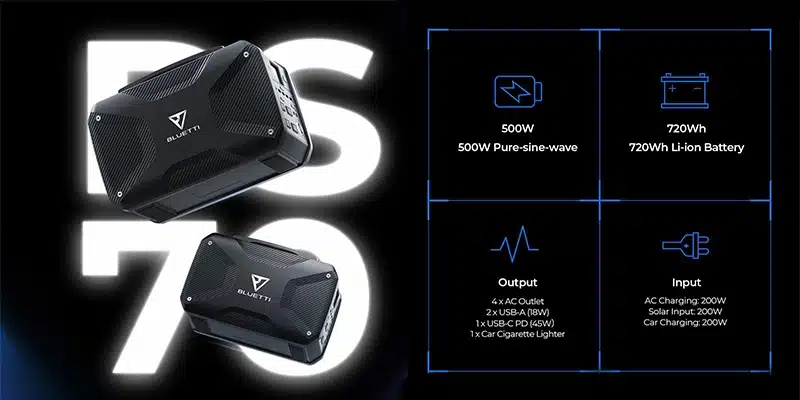
The Bluetti PS70 was a highly compact lithium solar power station with a 720Wh battery and a 500-watt inverter. It is not part of the 2026 Bluetti catalog in most regions; the notes below describe the unit as it was sold, including its light profile and handy design.
The specs and images of the product first surfaced on the Bluetti Power Stations Facebook club. Bluetti briefly sold the PS70 on its website alongside crowdfunding bundles; as of 2026 the PS70 is no longer a current catalog item in most regions.
The PS70 features four AC outlets and 200W charging input each from solar, AC, and car sources. Other attractions are two USB-A 18W, one USB-C 45W PD, and a cigarette lighter port.
PS70 has a weight of just 8 kg and was offered with a two-year warranty. Though having almost the same specs as its popular model EB70S, the device equips a lithium battery, not a LiFePO4 unit.
| 2026 availability: Bluetti lists the EB70S as discontinued on its Canadian store and points shoppers to newer compact LiFePO4 models such as the AC70 (768Wh, 1000W class). If you need a similar capacity today, compare the Bluetti AC70 or shopfor current pricing. |
Bluetti PS70 at a Glance

- 720Wh Compact Lithium Solar Power Station.
- 500W Pure Sine Wave Inverter.
- 200W Solar, AC, and Car Charging Inputs.
- Four AC Sockets, Three USB Ports.
- 12V Cigarette Lighter Charger.

Bluetti PS70 vs Bluetti EB70S
With its specs, the PS70 looks like a lithium-ion variant of the brand’s much popular EB70S LFP compact power station with a less powerful inverter. The EB70S is a 716Wh power station with an 800W inverter (1400W surge) and LiFePO4 cells—the chemistry most buyers prefer for cycle life.
Having a lithium battery inside, PS70 was a little lighter than EB70S, but third-party reviews in 2022–2023 noted the EB70S as the better long-term buy because of LiFePO4 and higher AC output. Street pricing for the EB70S often landed near $429–$499 before discontinuation.

Robert DeWitt writes about off-grid power gear for Off Grid Power Boom. Based in Arizona, he uses portable power stations, solar panels, and battery systems regularly in extreme heat—focusing on practical runtime, charging speed, reliability, and real-world usability for camping, RV trips, and home backup.
Editorial focus: portable power stations & solar generators, solar panel setups, batteries/inverters, and off-grid preparedness.