
Disclosure: This guide contains affiliate links. If you buy through our Amazon links, we may earn a commission at no extra cost to you. We only recommend products researched against manufacturer specs, independent reviews, and current market listings.
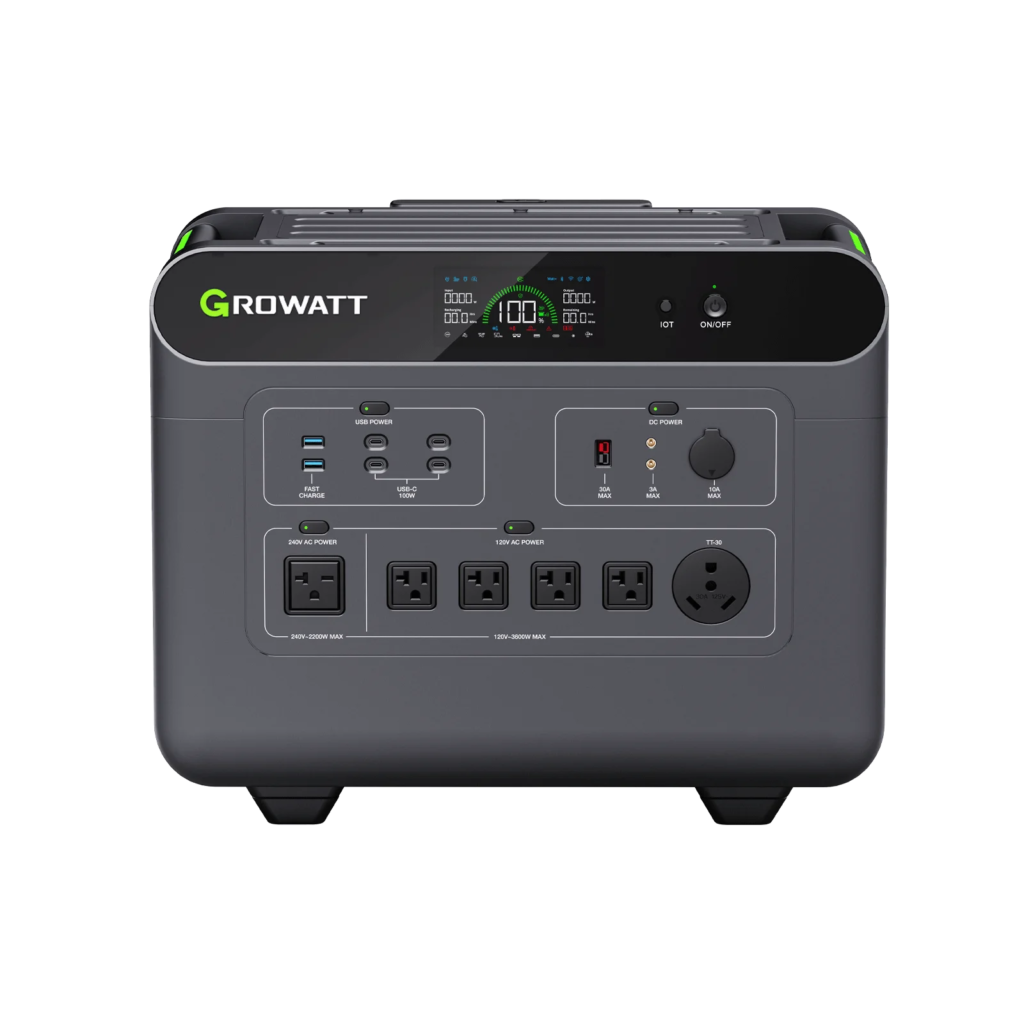
The GROWATT HELIOS 3600 is Growatt’s flagship portable solar generator for homeowners and RVers who want professional-inverter brand DNA in a rollable LiFePO4 brick. At roughly 3,686 Wh of EV-grade LFP capacity and 3,600 W continuous AC (about 4,500 W surge), it sits squarely in the 2026 “essentials-to-partial-home” tier—expandable toward 36 kWh, dual-unit 240 V / 7,200 W split-phase, up to 2,000 W solar, a native NEMA TT-30 RV outlet, and cold-start marketing down to about −22°F. This GROWATT HELIOS 3600 review walks through real load math, expandability cost, 240 V paths, solar recharge, and how it stacks up against the Anker SOLIX F3000, BLUETTI Apex-class modulars, Jackery Explorer 2000 Plus, and Oupes Mega 5 so you can buy for your load list—not brochure watts alone.
If you are still mapping the broader market, start with our best portable power stations comparison, the brand hub Bluetti vs EcoFlow vs Jackery, and our home-backup ladder piece Anker SOLIX F3800 Plus vs EcoFlow DELTA Pro. Smaller camping-first buyers should also read the Jackery Explorer 2000 Plus review before committing ~50 lb of garage hardware.
Executive summary: who should buy the HELIOS 3600?
Buy the GROWATT HELIOS 3600 if you want a Growatt-branded modular station with strong base capacity (~3.7 kWh), a serious 3,600 W inverter, RV TT-30 convenience, high solar input (2,000 W class), and a documented path to dual-unit 240 V plus multi-pack expandability into the tens of kilowatt-hours. It is a natural fit for storm-prep suburban homes, light whole-home critical circuits with a transfer inlet, workshop tools on pure sine, and travel trailers that already speak NEMA TT-30 language.
Skip or wait if you need a single-brick dual-voltage “one unit does 240 V forever” story without a second chassis, if brand recognition and app polish matter more than Growatt’s solar-inverter heritage, or if your real need is a 1–2 kWh camping daypack. Also pause if your budget only covers the base unit but your load plan assumes 20+ kWh of expansion packs on day one—model total system cost before you fall in love with the 36 kWh ceiling.
Street context (August 2026 research cycle): base ASIN often near $1,599 (list marketing near $2,099), solar kit and expansion packs each near base-unit money, and a dual-unit split-phase combo marketed near $3,199. Prices move weekly—always confirm the live Amazon or Growatt portable store listing before checkout.
What is the GROWATT HELIOS 3600?
Growatt is better known globally for hybrid inverters and residential solar electronics than for consumer “camping bricks.” The HELIOS 3600 is the company’s bid to own the expandable portable tier with pro-grade LFP cells, dense port layout (about 16 ports across AC, USB, 12 V, and specialty I/O), and modular architecture that scales from a single luggable ~51 lb unit to a multi-battery home energy island. Marketed capacity is commonly rounded to 3600 Wh; the more precise figure cited across Growatt portable materials is about 3,686.4 Wh at a 51.2 V LFP pack architecture.
Positioning matters. This is not a 300 W picnic UPS and not a wall-mounted 10 kWh Tesla-class install. It is a portable whole-home lite platform: enough inverter to start many household compressors and power tools, enough base energy for multi-day fridge and communications if you manage loads, and enough expansion headroom that multi-day heat-wave outages become a battery-shopping problem rather than a generator-only problem.
Compared with pure consumer brands, Growatt’s pitch is ecosystem adjacency—buyers who already trust Growatt inverters, hybrid charge controllers, or commercial solar may prefer one support path for portable backup. Compared with EcoFlow and BLUETTI, HELIOS trades some app maturity and mass-market mindshare for price-per-watt competitiveness and split-phase dual-unit scaling.
Core specifications at a glance
| Spec | GROWATT HELIOS 3600 |
|---|---|
| Battery chemistry | LiFePO4 (EV-grade LFP) |
| Base capacity | ~3,686 Wh (marketed ~3600 Wh) |
| Expandable capacity | Up to ~36 kWh with expansion packs / multi-unit path |
| Continuous AC output | 3,600 W |
| Surge AC output | ~4,500 W |
| Dual-unit / split-phase | Path to 240 V / ~7,200 W with second unit + hub |
| Solar input | Up to ~2,000 W MPPT |
| AC recharge | ~1.5 h @ 240 V / ~3 h @ 120 V (manufacturer class) |
| UPS / EPS switchover | <15 ms class |
| Cycle life | ~4,000 cycles to 80% |
| Cold-start | Down to about −22°F (marketing) |
| Notable ports | NEMA TT-30 RV, Anderson I/O, multi USB-C/A, ~16 total |
| Weight / size | ~51 lb; ~20.4 × 12.3 × 16.5 in |
| Warranty | 5-year manufacturer positioning |
| Typical street (base) | ~$1,599 (verify live) |
Treat surge and cold-start numbers as manufacturer claims until you validate against the manual for your firmware and ambient conditions. Continuous ratings assume proper ventilation and staged inductive loads—do not plan to hold every outlet at nameplate watts simultaneously in a hot garage.
Capacity and runtime: what 3.7 kWh actually runs
Base capacity on the HELIOS 3600 is intentionally a tactical reservoir, not unlimited whole-home fuel. A modern frost-free refrigerator often averages 100–150 W with 600–1,200 W compressor starts. Fridge + modem/router + LED lighting + phone/laptop charging can land around 1.5–2.5 kWh per day depending on ambient temperature and door openings. That means a full HELIOS base pack can cover roughly 1.5–2.5 days of essentials if you are disciplined—and far less if you add space heaters, hair dryers, or window ACs without solar recovery.
Add a 5,000 BTU window air conditioner (often 400–600 W running, higher start) and you leave “base-only multi-day” territory quickly unless midday solar is strong. A microwave (1,000–1,500 W) is a short-burst load: fine on a 3,600 W inverter, expensive in watt-hours if used constantly. Well pumps and some mini-splits are where surge headroom and 240 V planning matter more than average Wh math.
Use a written load table before you buy expansion packs: nameplate watts, duty cycle, must-run vs nice-to-have, and daily kWh. Our broader planning context lives in best solar home battery and backup systems and the ecosystem deep-dive EcoFlow DELTA Pro vs BLUETTI AC500.
Inverter power, surge, and pure sine behavior
Continuous 3,600 W puts HELIOS in the same inverter class as many mid-home portables (Anker F3000-class, several BLUETTI modulars) and well above classic 2,000 W camping stations. That headroom matters for simultaneous fridge + microwave, shop vacuums, circular saws, and some induction cooktops on lower power settings. The ~4,500 W surge rating helps with motor starts, but locked-rotor amps on large pumps can still exceed what any single portable claims—always stage motors and measure real draw when possible.
Pure sine output is non-negotiable for modern electronics, variable-speed furnaces, and CPAP machines. Growatt markets pure sine across the HELIOS AC outlets; still, sensitive medical gear should be tested on a short outage drill before you depend on it overnight. Keep 20–30% state-of-charge reserve for communications and medical loads when storms are multi-day.
If your load script regularly needs 5–6+ kW continuous, look up-tier to platforms like the Anker SOLIX F3800 Plus class covered in our F3800 Plus vs DELTA Pro guide, or plan dual HELIOS units for 7,200 W continuous at 240 V rather than expecting one brick to be a standby generator replacement.
Expandability to 36 kWh: the real cost story
Marketing ceilings sell dreams; invoices sell reality. HELIOS expandability toward ~36 kWh is the long-game feature that separates it from fixed 2–3 kWh Jackery-style bricks. Expansion batteries on Amazon have tracked near $1,500–$1,600 each in our research window—nearly the price of another base unit. That means scaling from 3.7 kWh to ~11 kWh can easily double or triple hardware spend before you buy solar panels, transfer gear, or a second unit for split-phase.
When is expansion worth it? If your outage profile includes multi-day grid failures, medical devices, freezers full of food, or remote property autonomy with limited generator fuel, yes—buy capacity early while kits are in stock. If you only need overnight fridge and Wi-Fi a few times a year, a single HELIOS base (or a cheaper 2 kWh expandable) may be the rational stop. Value shoppers comparing dollars per kilowatt-hour should also glance at budget expandables in the AFERIY class and mid Anker C-series, then return to HELIOS when 240 V and Growatt brand trust matter.
240 V split-phase and dual-unit pairing
True North American 240 V loads—well pumps, many dryers, some HVAC air handlers, EVSE on lower amperage—often need split-phase rather than a single 120 V inverter. HELIOS addresses this with a dual-unit path to roughly 7,200 W / 240 V, typically sold as a combo kit (street near $3,199 in our August 2026 scrape) rather than a free software unlock on one chassis. Budget for the hub/cabling and the second power station as first-class costs, not accessories.
Operationally, dual-unit systems add weight, floor space, and failure modes (one unit offline halves capability). They also unlock serious workshop and homestead use cases that single 120 V bricks cannot touch. If you know you need 240 V on day one, price the official split-phase kit against competitors that advertise single-unit dual-voltage (for example some BLUETTI Apex configurations) and against traditional transfer-switch + generator solutions.
Never backfeed a main panel with extension cords. Use an approved inlet box and interlock or a listed transfer switch, and hire a licensed electrician when local code requires it. Portable stations remove fuel logistics; they do not remove interconnection safety.
Solar charging: 2,000 W MPPT in practice
Up to 2,000 W solar input is a standout HELIOS number versus older 800–1,200 W camping stations. On paper, a full 3.7 kWh pack can approach a ~2–3 hour solar refill under ideal irradiance with a correctly sized array—Growatt marketing often cites roughly 2.8 hours solar full under ideal conditions. Reality includes panel temperature derating, MPPT voltage windows, cable losses, clouds, and roof orientation. Undersized 200–400 W suitcase panels will not hit the 2,000 W ceiling; plan array watts and open-circuit voltage carefully against the manual.
Hybrid AC + solar charging (combined input toward multi-kilowatt class) is useful when the grid flickers back on midday while panels still produce. For silent homestead recovery, prioritize south-facing fixed or ground mounts over folding briefcases once you commit to HELIOS-class hardware. Bundle SKUs that include a 400 W panel are convenient starter kits but are not a complete 2 kW array—treat them as a first step.
Ports, RV TT-30, UPS, and cold weather
Port density is part of the HELIOS value proposition: roughly sixteen outputs spanning household AC, USB-C/A, 12 V, Anderson-style I/O, and the RV-favorite NEMA TT-30. TT-30 alone can justify HELIOS for travel-trailer owners who hate adapter spiders. Anderson connectors simplify high-current DC accessories and some solar input paths depending on kit wiring.
EPS/UPS switchover under 15 ms is in the class that keeps many computers and modem/routers online during brief blips. It is not a guarantee for every industrial PLC or ultra-sensitive lab instrument—test your critical gear. Cold-start down to about −22°F is relevant for unheated garages and mountain properties; still, LiFePO4 charging below freezing usually requires thermal management—read the charge-temperature limits before winter camping assumptions.
At ~51 lb and roughly 20 × 12 × 16 inches, HELIOS is luggable, not backpackable. Plan two-hand carries, a rolling cart for multi-story homes, and secure tie-downs in a truck bed. Compare that form factor with lighter 2 kWh units like the Jackery Explorer 2000 Plus if portability trumps expandability.
App, BMS, warranty, and support realism
Growatt ships a mobile app story for monitoring and some control, but third-party reviews in 2025–2026 still mention occasional app flakiness compared with Anker and EcoFlow. Treat the app as convenience, not the reason to buy. The battery management system (BMS) marketing emphasizes multi-layer protection and ~4,000 cycles to 80%—solid LFP-class longevity if cells and thermal design hold up in field use.
Warranty positioning is a 5-year manufacturer path. Register promptly, keep proof of purchase, and understand whether coverage is capacity-threshold based or defect-only. Brand support reputation is more mixed on pure consumer forums than Anker’s mainstream channel strength; professional solar buyers may already have Growatt service relationships that tip the scale the other way.
Amazon ratings in our research window landed around 4.3/5 across roughly 100+ reviews on primary ASINs, with independent hands-on coverage in the mid-4s. That is credible but not “category default” mindshare. Expect some DOA/support anecdotes on any high-power portable SKU—buy from sellers with clear returns.
GROWATT HELIOS 3600 vs Anker SOLIX F3000
The closest same-week rival from our Monday research cycle is the Anker SOLIX F3000: about 3,072 Wh, 3,600 W continuous, expandable toward 24 kWh, strong dual-voltage solar (up to ~2,400 W marketing), UL9540 system certification messaging, and Anker’s brand-trust conversion. Street pricing near $1,500 makes F3000 a safer “spouse approval” buy for many US households.
HELIOS counters with higher base Wh (~3.7 vs ~3.1), Growatt solar-pro branding, aggressive 36 kWh ceiling marketing, and TT-30-forward port layout. Anker counters with UL9540 narrative, polish, and ecosystem ladder into F3800 Plus territory already covered on this site. Choose Anker when support reputation and certification storytelling dominate; choose HELIOS when base capacity, Growatt affinity, and multi-pack homestead scaling dominate.
HELIOS 3600 vs Jackery, Oupes, BLUETTI, and EcoFlow class
Against the Jackery Explorer 2000 Plus, HELIOS wins on raw capacity, inverter watts, and expandability; Jackery wins on brand familiarity and lighter portable ergonomics for camping. See our Jackery 2000 Plus review if weekend car camping is 80% of your use case.
Against Oupes Mega 5 home-backup positioning, both chase multi-day essentials; compare current street $/Wh, port layouts, and whether you prefer Oupes value marketing versus Growatt’s inverter heritage. Our Oupes Mega 5 coverage remains the internal benchmark for that lane.
Against BLUETTI modular Apex-class and EcoFlow DELTA Pro ecosystems, HELIOS is the outsider brand with competitive iron. BLUETTI often leads single-unit dual-voltage storytelling; EcoFlow leads smart-panel accessory depth. HELIOS is the pick when you want Growatt-labeled hardware and Amazon-available expansion without locking into those two ecosystems—cross-read Bluetti vs EcoFlow vs Jackery and DELTA Pro vs AC500 ecosystems before you standardize on one vendor for a decade of packs.
Pros and cons
Pros
- ~3,686 Wh LFP base with path toward ~36 kWh expandability
- 3,600 W continuous / ~4,500 W surge pure sine inverter class
- Dual-unit 240 V / ~7,200 W split-phase option for serious homestead loads
- Up to ~2,000 W solar input for fast silent recovery
- Native NEMA TT-30 RV outlet plus dense ~16-port layout
- <15 ms UPS-class switchover; cold-start marketing to −22°F
- ~4,000 cycles to 80%; 5-year warranty positioning
- ~51 lb luggable form; active Amazon ASINs with kit options
- Growatt professional solar-inverter brand adjacency
Cons
- Less mainstream portable-brand recognition than Jackery, Anker, EcoFlow
- App experience reported as uneven versus top consumer apps
- True 240 V needs second unit + hub cost
- Expansion packs nearly as expensive as the base station
- 51 lb is not backpack camping gear
- Some mixed DOA/support anecdotes typical of high-power Amazon SKUs
- Street pricing still premium versus pure budget expandables
Who should buy — buyer personas
Suburban storm prepper: Base HELIOS + inlet/interlock covers fridge, lights, internet, and medical devices through multi-day events if you add solar or a small generator top-off. Skip dual-unit 240 V until you document a well pump or dryer requirement.
RV / travel trailer owner: TT-30 native output is the feature. Pair with flexible solar on the roof for boondocking; mind weight when loading the tongue or truck bed.
Homestead / light off-grid: Plan expansion packs and dual-unit 240 V early. HELIOS becomes a modular island rather than a closet UPS. Budget transfer equipment and array hardware as part of day-one cost.
Workshop / jobsite: 3,600 W pure sine runs many tools; still stage compressors and avoid continuous max loading in heat. Consider dual units if you need 240 V tools.
Budget first-timer: Look at sub-$800 expandable 2 kWh class first; graduate to HELIOS when you outgrow capacity and need Growatt-class inverter headroom.
Buying guide: which ASIN and kit?
- Base unit (B0DF7SZJWY): Best default if you already own solar or will add panels later.
- Base + 400 W solar kit (B0DF7VYKHH): Convenient starter; still undersized versus the 2,000 W input ceiling.
- Expansion battery (B0DF7VK4FF): Buy when multi-day runtime is proven necessary—not as impulse day-one bloat.
- Split-phase dual combo (e.g. B0DKWXX136 class): Only when 240 V loads are documented and budgeted.
Confirm seller, returns, and whether the listing is Amazon’s Choice versus third-party marketplace stock. Prices and kit contents change; the affiliate buttons below always resolve to the live product page.
Setup, safety, and code-aware tips
Unbox, charge to 100% once, update firmware if the app offers it, and run a 30-minute load test with your fridge and modem before storm season. Label extension cords with gauge and max amps. Keep the unit off carpet pile that blocks intake, and never operate in standing water. For home interconnection, use listed transfer equipment only—portable power is not a license to defeat utility anti-islanding protections.
Store around 40–60% SOC if unused for months, and cycle every few months. LFP hates chronic 100% storage in heat as much as chronic deep discharge. If you add solar, verify VOC stays inside HELIOS MPPT limits on the coldest sunny morning—cold panels raise voltage.
Final verdict
The GROWATT HELIOS 3600 earns a strong recommendation as a pro-solar-brand expandable portable for 2026 buyers who need real 3.7 kWh / 3,600 W iron, RV TT-30 convenience, high solar input, and a credible path to 240 V dual-unit and multi-pack autonomy. It is not the most famous logo on the shelf, and expansion economics demand sober spreadsheets, but it fills a clear gap on Off Grid Power Boom between camping 2 kWh bricks and trolley-class 6 kW flagships.
Buy HELIOS 3600 when Growatt trust, base Wh, and modular homestead scaling matter. Buy Anker F3000 when UL9540 storytelling and mainstream support matter more. Buy Jackery 2000 Plus-class when weight and brand simplicity beat expandability. Step up to F3800 Plus / DELTA Pro class when continuous kilowatts and smart-panel ecosystems dominate the load list.
Ready to verify live pricing and kit availability?
Check current GROWATT HELIOS 3600 deal on Amazon
Frequently Asked Questions
It can cover critical circuits and many partial-home loads with proper transfer gear, load management, and optional expansion packs. It is not a permanent automatic standby generator with unlimited fuel. Plan essential circuits first, then expand capacity if multi-day outages are common in your area.
Growatt markets expansion toward roughly 36 kWh using additional battery packs and multi-unit configurations. Each expansion pack can cost nearly as much as the base unit, so model total system price before assuming you will max the ceiling.
Yes via a dual-unit path (about 7,200 W / 240 V with the appropriate hub/kit). A single base unit is primarily a high-power 120 V class station with TT-30 and standard household outlets—budget the second unit if you need well pumps or other 240 V loads.
With up to about 2,000 W of compatible solar input and ideal sun, manufacturer materials suggest on the order of ~2.8 hours for a full charge. Real-world times depend on array size, weather, temperature, and cable losses. A single 400 W suitcase panel will be much slower.
Both target ~3 kWh-class expandable home backup with 3,600 W inverters. HELIOS offers higher base Wh and a higher marketed expansion ceiling; Anker often wins on brand trust, UL9540 messaging, and app polish. Pick based on ecosystem preference and total expanded system cost, not base sticker alone.
About 51 lb for the base unit—portable between garage and driveway or into an RV bay, not a hiking pack. Use two hands, a cart for stairs, and secure mounting in vehicles.

Robert DeWitt writes about off-grid power gear for Off Grid Power Boom. Based in Arizona, he uses portable power stations, solar panels, and battery systems regularly in extreme heat—focusing on practical runtime, charging speed, reliability, and real-world usability for camping, RV trips, and home backup.
Editorial focus: portable power stations & solar generators, solar panel setups, batteries/inverters, and off-grid preparedness.