
Researched August 16, 2026 from Mango Power’s US store and the product FAQ on mangopower.com. Not a lab test. We have not timed runtimes or charging on this unit. Specs below are the manufacturer’s.
The Mango Power E is a wheeled 3.5 kWh-class station. Mango lists 3533Wh of CATL LFP, 3000W AC (four 20A outlets), up to 2000W solar (60–150V), and a 30A RV outlet. Street price on the US store this week is about $1,299 for the base unit. The $4,250 figure on the same page is a crossed-out list, not a price we treat as real.
It is a real, shipping product in August 2026. It is also a smaller brand than EcoFlow, Bluetti, or Jackery. Buy it for the watt-hours per dollar and the CATL pack, not for app polish or a long US retail trail. If you need a brand with wide service coverage, start with the brand hub or the current shortlist.
What Mango lists
| Capacity | 3533Wh (marketed 3.5 kWh) |
| Chemistry | CATL LFP |
| AC output | 3000W total, 4 × 20A |
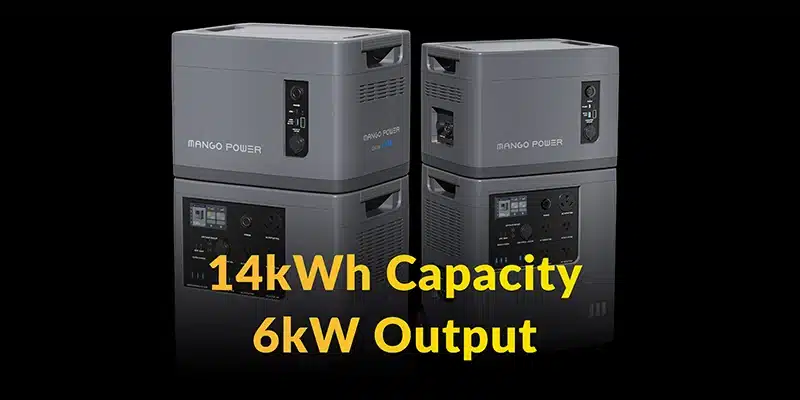
| Expansion | One extra battery → 7066Wh. Two E+battery bundles → about 14 kWh (Mango FAQ) |
| 240V | Split-phase with mSocket Pro; dual-unit path to about 6 kW (kit, not the base brick alone) |
| Solar in | Max 2000W, 60–150V. Mango says at least two panels in series, up to three |
| AC in | Max 3000W on the spec table; FAQ also says 3300W grid / EV with adapter |
| Fast charge | 0–80% in 1 hour, full in 1.5 hours — only with the separate 30A cable and 30A input setting |
| Cycle claim | 6000 cycles to 70% at 25°C, 0.5C. “20 years” assumes a full cycle every 1.5 days. We have not aged a pack |
| Weight / size | 100.1 lb (45.4 kg); 17.8 × 13.6 × 19.4 in |
| Ports | USB-A 6× QC3 24W; USB-C 65W + 100W; 12V car 10A; 2× DC5521 12V/5A; 30A RV |
| Ingress | IP21 (drip / large objects). Not a rain unit |
| Warranty | Store banner says 10 years. The same product FAQ says five years. Confirm the card you actually get |
Who it is for
The base E covers fridge, lights, and communications for a short outage if you manage loads. At 100 lb it is a garage cart, not a camping pack. 240V dryers, wells, and “whole home” stories need the extra battery and mSocket Pro / mPanel kits. Price those as first-class costs. Mango’s 14 kWh / 6 kW ceiling is a kit, not the $1,299 brick.
One store review on mangopower.com says the unit does not do pass-through charging and that the app is buggy. That is a customer report, not a measurement here. If you need UPS-style pass-through, confirm it on the current firmware before you buy.
How it compares
Same week, EcoFlow DELTA Pro and Bluetti’s modular home units have deeper US retail and accessory ecosystems. Jackery’s Explorer 2000 Plus is the camping-familiar expandable. The E’s pitch is CATL cells and a low street price for 3.5 kWh / 3 kW. We have not ranked it on a bench. For the current shortlist see portable power stations. For home-backup kits see home backup.
Buying notes
As of August 16, 2026 the live buy path we verified is Mango’s US store (about $1,299 base). Amazon listings exist (base ASIN B0CHB4XSGH among others); confirm the live seller and stock before checkout. We are not treating the $4,250 crossed-out list as a real price. 400W panels were listed out of stock on Mango’s store with about a one-month slip.
FAQ
Is Mango Power still in business? Yes as of this research date. The US store is selling the E and kits. The company is a smaller brand than the three names most people search.
Can one E run a house? Critical circuits, maybe, with a transfer inlet and load discipline. It is not a standby generator. Plan the extra battery and 240V kit only if those loads are on your list.
Did we test it? No. This page is a specs note from manufacturer materials dated August 16, 2026.

Robert DeWitt writes about off-grid power gear for Off Grid Power Boom. Based in Arizona, he uses portable power stations, solar panels, and battery systems regularly in extreme heat—focusing on practical runtime, charging speed, reliability, and real-world usability for camping, RV trips, and home backup.
Editorial focus: portable power stations & solar generators, solar panel setups, batteries/inverters, and off-grid preparedness.