

Last updated: September 21, 2026
Researched from Soliom manufacturer pages, September 21, 2026. Not a lab test. We did not run these cameras. Specs below are the maker’s published numbers. Stock and listing SKUs rotate — confirm on soliom.net before you buy.
People searching Soliom S600 vs S800 usually want a short, honest compare of two Soliom solar outdoor security cameras: battery size, pan/tilt range, and whether the solar panel is included. This page is a specs comparison from maker-published numbers, not a ranked “best of” list and not a lab test.
Soliom also sells solar outdoor cameras alongside other brands we cover in our Reolink vs Soliom vs Ring roundup. A solar outdoor camera is still a battery camera — the panel tops up the pack so you can mount it where grid power is awkward.
Quick take: who each is for
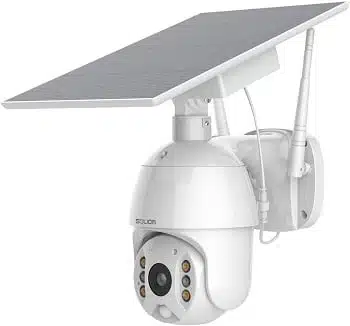
- Soliom S600 — the lighter pack (maker: 9000 mAh), pan/tilt about 320° / 90°, and historically the camera-plus-panel bundle. Prefer when you want the smaller battery and a lower street price. Confirm today’s bundle on soliom.net or Amazon.
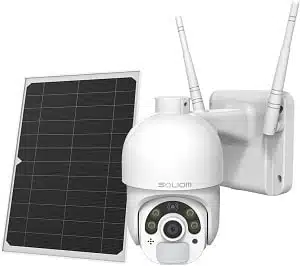
- Soliom S800 — the larger pack (maker: 14400 mAh), wider pan about 355° / 90°, and historically sold as camera-first with a compatible panel sold separately. Prefer when you want the bigger battery and wider sweep. Confirm panel inclusion on the live listing.
As of September 21, 2026, Soliom’s current US catalog pages center on S600 4G and S800C 4G cellular variants on soliom.net (maker lists ~9000 mAh for S600 4G and ~14400 mAh for S800C 4G). The Amazon ASINs linked below may still be Wi-Fi / earlier SKU listings — check the product title and maker page before you buy. Cellular models need a data plan after any trial SIM; Soliom FAQ states 4G units do not also do Wi-Fi.
Soliom S600 at a glance
 |  | |
|
| |
Soliom S800 at a glance
 | | |
|
| |
Soliom S600 vs S800 comparison
Both models are Soliom solar-chargeable outdoor security cameras. The main published differences are battery capacity (9000 mAh vs 14400 mAh), pan range (about 320° vs 355°), and how the solar panel was bundled historically (S600 often with panel; S800 often camera-first with a compatible panel sold separately). Features such as PIR motion sensing, 1080p day video, color night vision, two-way audio, and card/cloud storage options appear on both maker-facing lists. That is Soliom’s published framing — we did not lab-test clarity, detection range, or battery life.
For a side-by-side of the two glance lists:
| Spec (maker) | S600 | S800 |
|---|---|---|
| Battery | 9000 mAh | 14400 mAh |
| Pan / tilt | ~320° / 90° | ~355° / 90° |
| Video (listed) | 1080p + color night vision | 1080p + spotlight color night vision |
| Motion | PIR | PIR |
| Audio | Two-way | Two-way |
| Storage | Up to 128 GB card and/or Soliom cloud | Up to 128 GB card and/or Soliom cloud |
| Solar panel (historical listing note) | Often bundled with camera | Often sold separately — confirm listing |
Price and availability
Street prices move. We do not quote a fixed dollar figure here. Check Soliom’s current US listing on soliom.net and the Amazon links above before you buy — camera-only versus camera-plus-panel bundles are priced differently. The S600 has usually been the more affordable of the two, but confirm today’s numbers at the source. Soft stock as of September 21, 2026: maker pages for S600 4G and S800C 4G were listed for sale on soliom.net; Amazon availability for the ASINs above can flip independently.
Final thoughts
That is our Soliom S600 vs S800 compare: same job (solar outdoor security), different battery and pan range on the maker sheet. Pick the pack size and pan sweep that match the mount, then re-check whether you need Wi-Fi or 4G for that install. For cellular trail / property cams instead of Wi-Fi outdoor cams, see our Vosker vs Spypoint solar cellular trail cameras compare.
Related how-to

Robert DeWitt writes about off-grid power gear for Off Grid Power Boom. Based in Arizona, he uses portable power stations, solar panels, and battery systems regularly in extreme heat—focusing on practical runtime, charging speed, reliability, and real-world usability for camping, RV trips, and home backup.
Editorial focus: portable power stations & solar generators, solar panel setups, batteries/inverters, and off-grid preparedness.