
Portable “EV solar charging kits” can be a legitimate emergency tool — but only if you understand the energy math, the practical constraints, and what “miles of range” really means in your conditions.
Quick take
| Feature | Details |
|---|---|
| Product | EVSolarKits Portable EV Solar Charging Kit |
| Type | Portable solar charging kit for EVs |
| Solar Input | Varies by kit (100W-400W typical) |
| Compatible EVs | Any EV with J1772 or Type 2 port |
| Buy on Amazon | |
| Last Updated | 2026 |
- Be conservative with range claims. Your sunlight, panel angle, temperature, and conversion losses matter more than headline watts.
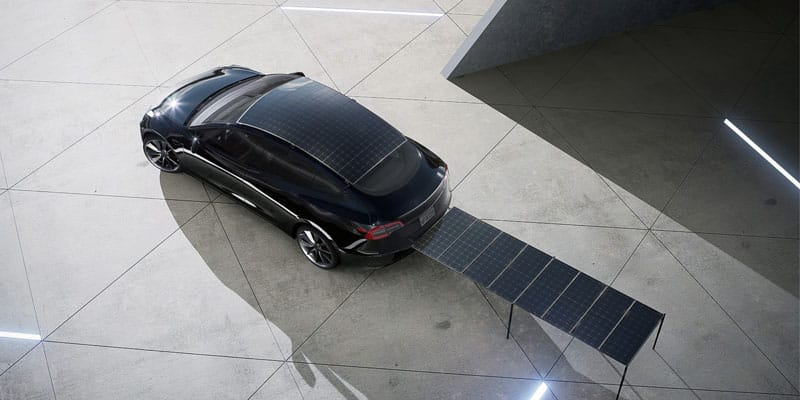
- Rooftop solar alone won’t meaningfully charge an EV. Most of the usable energy comes from a deployable ground array, not a small roof film.
- Most realistic setup: deployable solar → battery (power station) → EVSE. Size the battery and inverter to your charging method.
What EVSolarKits claimed (and what to verify)
EVSolarKits was promoted as a combination of a roof array, deployable panels, and a battery pack, with marketing claims like “up to 60 miles/day” and “up to 150 miles over two days.” Treat those as best‑case targets.
Before you plan around it, verify: (1) total deployable panel wattage, (2) how the system outputs power (AC EVSE vs DC), (3) battery capacity (kWh), and (4) continuous inverter output (kW).
Do the energy math (simple and honest)
Use this quick estimator:
- Solar kWh/day ≈ (panel watts × full-sun-hours ÷ 1000) × 0.7 (loss factor)
- Miles/day ≈ (solar kWh/day × 1000) ÷ (your EV Wh/mi)
- Example: a 2,000W deployable array with 4 full-sun-hours gives ≈ (2000×4/1000)×0.7 ≈ 5.6 kWh/day. At ~250 Wh/mi, that’s ~22 miles/day — not 60.
Practical constraints off-grid owners run into
- Security + setup time: you need space and time to lay out panels (and not have them walk off). In my Arizona testing, I’ve seen people lose panels to wind in just 15 minutes.
- Heat derating: panels and inverters can produce less in hot conditions. In 105°F+ temps, expect 15-20% output reduction.
- Charging limits: if you’re using Level 1 (120V), you may be capped around ~1.2–1.9 kW depending on settings and circuits.
Authority recommendation
If your goal is reliable off-grid EV charging, prioritize a proven approach: a quality deployable solar array, a right-sized battery/inverter, and a known EVSE. Evaluate any “kit” primarily on measured kWh delivered per day, not marketing miles.
FAQ
Not realistically. The roof area limits wattage; meaningful charging requires a much larger deployable array and good sun.
Total solar watts (deployable), battery capacity (kWh), inverter continuous output (kW), and whether it supports your preferred EV charging method (Level 1 vs Level 2).
In real field use, most “EV solar kit” setups deliver roughly 30–60% of their best-case marketing output once you factor in heat, suboptimal angles, conversion losses, and setup realities. Kits with detachable panels you can aim at the sun consistently do better than roof-only concepts.
A dedicated portable power station paired with a quality deployable solar array is usually more predictable because the components are designed to work together (MPPT limits, cable runs, inverter sizing). The “kit” approach only works well when the specs are honest and the system is sized around kWh delivered—not miles claimed.
Related articles
- Bluetti AC200Max vs Bluetti AC300: What are the Differences Between the Two Modular Bluetti Solar Power Stations?
- EcoFlow Smart Generator vs Dual Fuel Smart Generator
- EcoFlow vs Jackery: EcoFlow Delta vs Jackery Explorer 1500 Solar Generators
Sources
- Torque News — EVSolarKits coverage + link to the Indiegogo campaign — Used for context on the promoted kit concept and mileage claims.
- Indiegogo — EV Solar Kits (campaign page) — Primary source for how the kit was positioned (may block automated fetch).
Robert DeWitt writes about off-grid power gear for Off Grid Power Boom. Pages are spec-checked unless a post says otherwise. Not a lab. Based in Arizona, with an editorial focus on runtime, charging speed, reliability, and usability for camping, RV trips, and home backup.
Editorial focus: portable power stations & solar generators, solar panel setups, batteries/inverters, and off-grid preparedness.
Where to buy / current options
- EV Solar Kits campaign page (for historical context and specs)
- Browse our portable power station guides (more realistic off-grid charging setups)
The EVSolarKits Portable EV Solar Charging Kit to Charge Your EV is available on Amazon and through the manufacturer’s official website. We recommend checking both for current pricing and availability.
Most off-grid power products come with a 1-2 year manufacturer warranty. Check the product specifications or manufacturer website for exact warranty terms and coverage details.
Many off-grid power products support solar charging. Check the product specifications for maximum solar input wattage and compatible connector types (MC4, Anderson, etc.).
Solar products can still charge on cloudy days but at reduced efficiency (typically 10-25% of full sun performance). Direct sunlight provides optimal charging.

Robert DeWitt writes about off-grid power gear for Off Grid Power Boom. Based in Arizona, he uses portable power stations, solar panels, and battery systems regularly in extreme heat—focusing on practical runtime, charging speed, reliability, and real-world usability for camping, RV trips, and home backup.
Editorial focus: portable power stations & solar generators, solar panel setups, batteries/inverters, and off-grid preparedness.