
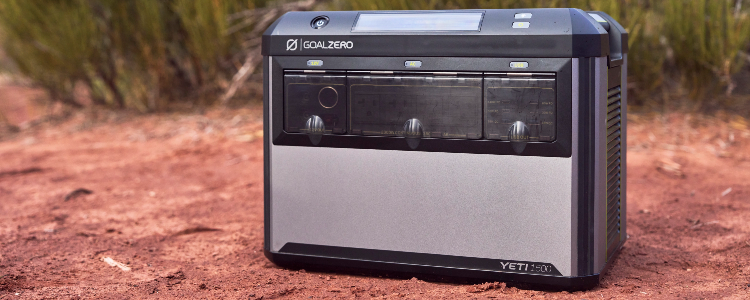
Published March 2026 — The Goal Zero Yeti 1500 is Goal Zero’s 6th-generation Yeti 1500. Goal Zero lists a 1,505Wh LiFePO4 battery, a 2,000W pure sine wave inverter, IPX4 weather resistance, and a 0-80% charge in 48 minutes. Popular Mechanics named it “Best Overall” solar generator for 2026; that is their ranking, not a test we ran.
- What it is: A 1,505Wh LiFePO4 portable power station with a 2,000W inverter and 14 output ports — built for off-grid living, overlanding, and home backup
- Price: $1,499.95 direct from Goal Zero
- Biggest pro: IPX4 weatherproof rating with 48-minute fast charge to 80%, both per Goal Zero’s published specifications
- Biggest caveat: At 53 lbs and $1,500, it’s heavy and premium-priced compared to competitors
Goal Zero Yeti 1500 Overview
Goal Zero’s Yeti line is their flagship portable power station. The 6th-generation Yeti 1500 is listed as switching from lithium-ion NMC to LiFePO4 (LFP). Goal Zero publishes 4,000+ charge cycles and a projected 10+ year lifespan of daily use.
Goal Zero lists IPX4 weather resistance on this generation, plus protective port shields, an aluminum chassis, and vibration testing for off-road conditions. That is the manufacturer’s claim, not a test we ran. IPX4 is splash resistance, not submersion.
The Yeti 1500 was named Best Overall Solar Generator for 2026 by Popular Mechanics, where reviewers noted it ran a modem, router, lamp, TV, and fan for over two days in a simulated blackout with capacity to spare. That kind of real-world performance, combined with the durability upgrades, makes a strong case for the premium price tag.
Key Specifications
Here’s the complete confirmed spec sheet for the Yeti 1500 6th generation:
| Battery Capacity | 1,505Wh LiFePO4 (51.2V, 29.4Ah) |
| Inverter Output | 2,000W Continuous / 3,600W Surge (Pure Sine Wave) |
| Weight | 52.75 lbs (23.93 kg) |
| Dimensions | 15.7 x 11.4 x 12.02 inches |
| AC Wall Charge | 1,500W max — 0-80% in 48 min, full in 1.1 hours |
| Max Solar Input | 900W combined (600W HPP + 300W 8mm) |
| Weather Rating | IPX4 (water resistant from all directions) |
| Battery Lifespan | 4,000+ cycles to 80% capacity (10+ years) |
| Output Ports | 14 total (4x AC, 4x USB-C, 2x USB-A, 4x 12V) |
| UPS Mode | Grid-to-battery switchover in under 15ms |
| Connectivity | WiFi + Bluetooth (Goal Zero Power App) |
| Warranty | 5 years |
Output Ports Breakdown
Goal Zero lists 14 output ports on the Yeti 1500. Here’s what you’re working with:
AC Power (4 ports): Four standard 120V/60Hz outlets rated at 20A each. Enough to run a full-size refrigerator, power tools, or a microwave simultaneously with other devices.
USB-C (4 ports): The standout is a 140W USB-C PD port, per Goal Zero’s published specifications. Whether that charges a given MacBook Pro at full speed depends on that laptop’s charger rating; we did not test it. There’s also a 60W port and two 30W ports for phones, tablets, and smaller devices.
USB-A (2 ports): Standard 18W Quick Charge ports for legacy devices and accessories.
12V High Power Port (HPP): Rated at 405W (13.5V, 30A), this is the port for van builds and permanent installations. It connects directly to Goal Zero’s ecosystem of 12V accessories.
12V Car Port: Standard cigarette lighter output at 162W (13.5V, 12A) for car-powered devices and coolers.
6mm Ports (2x): Dedicated 13.5V, 10A outputs for Goal Zero accessories like the Alta fridge line and Skylight camp lights.
Charging Speed and Solar Performance
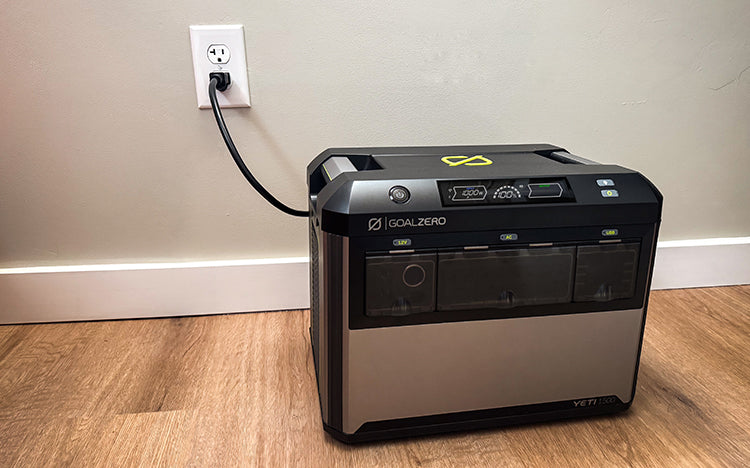
Charging speed, per Goal Zero’s published specifications: The 1,500W AC wall charger is built into the unit — no bulky external power brick needed. A complete 0-100% charge takes only 1.1 hours. Goal Zero lists 0–80% in 48 minutes on AC wall charging. That is the manufacturer’s figure, not a test we ran.
There’s also a clever input limit switch that lets you toggle between 1,500W “Ultrafast” mode and 750W “Low Speed” mode. The low-speed option prevents you from tripping household breakers when other appliances are running on the same circuit.
For solar charging, the Yeti 1500 accepts up to 900W of combined solar input — 600W through the HPP (High Power Port) and 300W through the 8mm port simultaneously. Here’s what real-world recharge times look like:
| Charging Source | Time to 100% |
| Wall Outlet (1,500W Fast) | 1.1 Hours |
| Solar (900W Max) | ~3 Hours (ideal sun) |
| Nomad 400 Solar Panel | 4.3 Hours |
| Nomad 200 Solar Panel | 8.6 Hours |
Popular Mechanics tested the unit with a Nomad 200W panel and measured 125–145W of actual input (about 70% efficiency), which is typical for real-world solar conditions. Expect roughly 50-75% of your panel’s rated wattage in practice.
Real-World Performance: What Can It Power?
Here are Goal Zero’s published runtime estimates:
| Device | Estimated Runtime |
| Full-Size Refrigerator | 19 Hours |
| Alta 50 Portable Fridge | 6.5 Days |
| Starlink Satellite Internet | 32 Hours |
| CPAP Machine | 20–24 Hours |
| Laptop Recharges | 25 Full Charges |
| Smartphone Recharges | 77 Full Charges |
| Microwave (1,000W) | 1.3 Hours |
| Coffee Maker | ~5 Pots |
The UPS (Uninterruptible Power Supply) mode is worth highlighting. With a grid-to-battery switchover time of under 15 milliseconds, the Yeti 1500 can keep sensitive electronics running through power outages without any interruption. Goal Zero lists UPS-mode switchover. For CPAP runtime math, see our CPAP backup guide; we did not test this Yeti on a CPAP or oxygen concentrator.
Build Quality and Durability
Goal Zero lists durability upgrades for this generation: an aluminum chassis, IPX4 water resistance, and protective port shields that snap shut over every outlet. Those are the manufacturer’s published claims, not a test we ran.
The unit has been vibration-tested for off-road conditions, making it suitable for overlanding rigs and truck beds on rough trails. Hidden behind rubber bumpers on the chassis are T-slot channels for mounting tie-downs, cable management, or custom brackets. There’s also a ground lug for permanent installations in vans or off-grid cabins.
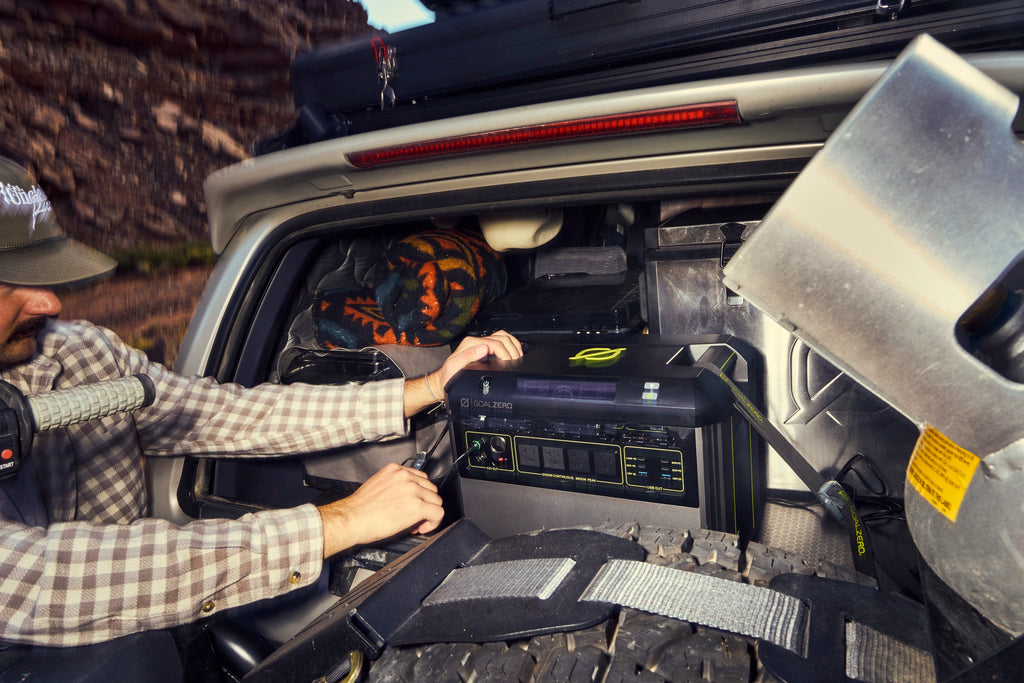
One thoughtful detail: internal LED port lights illuminate all the connection points, so you can plug in cables in the dark without fumbling with a headlamp. Small touch, but surprisingly useful at 2 AM during a power outage.
Pros and Cons
What We Like
- IPX4 weatherproof with port shields — Goal Zero lists IPX4 splash resistance and port shields. That is not a mud or rain test we ran.
- Fast charge: 0-80% in 48 minutes — The internal 1,500W charger eliminates the external brick and charges at up to 1,500W, per Goal Zero’s published specifications
- LiFePO4 with 4,000+ cycle lifespan — Goal Zero publishes 4,000+ cycles and a projected 10+ year lifespan to 80%. The 3–8× vs older lithium-ion comparison is the manufacturer’s claim, not a test we ran.
- 900W max solar input — Using both HPP and 8mm ports simultaneously means faster off-grid recharges , per Goal Zero’s published specifications
- 14 output ports including 140W USB-C PD — Goal Zero lists 14 ports. That is a spec count, not a campsite or office test we ran.
- UPS mode with under 15ms switchover — Goal Zero lists a sub-15ms switchover. We did not test medical equipment or servers on this unit.
- Popular Mechanics Best Overall 2026 — Their ranking, not a test we ran.
What Could Be Better
- Heavy at 53 lbs — About 7 lbs heavier than the previous 1500X; definitely a two-person lift or cart situation
- Premium price at $1,499.95 — You can get comparable capacity from Jackery or Bluetti for $500-700 less, though without the ruggedness
- Bluetooth app connectivity inconsistent — Multiple reviewers report the Goal Zero Power App drops connection; WiFi mode works better
- No legacy expansion battery support — The 6G is NOT compatible with older Yeti expansion modules or Tank batteries, which may frustrate existing Goal Zero owners
- Limited retail availability — As of March 2026, primarily available direct from Goal Zero; not yet widely stocked on Amazon
How It Compares: Yeti 1500 vs the Competition
| Feature | Goal Zero Yeti 1500 | Jackery 1000 V2 | EcoFlow Delta Pro | Bluetti AC180 |
| Capacity | 1,505 Wh | 1,070 Wh | 3,600 Wh | 1,152 Wh |
| Inverter | 2,000W / 3,600W | 1,500W / 3,000W | 3,600W / 7,200W | 1,800W / 2,700W |
| Weight | 53 lbs | 23.8 lbs | 99 lbs | 35.3 lbs |
| Solar Input | 900W | 500W | 1,600W | 500W |
| Weather Rating | IPX4 | None | None | None |
| Battery Life | 4,000+ cycles | 4,000 cycles | 3,500 cycles | 3,500+ cycles |
| Price | $1,499.95 | ~$799 | ~$2,000 | ~$800 |
The Jackery Explorer 1000 V2 is the obvious value pick — it’s half the price, half the weight, and still uses LiFePO4. But it lacks weather resistance, has fewer ports, and maxes out at 500W solar input. If budget matters more than ruggedness, Jackery is the smarter buy.
The EcoFlow Delta Pro is for people who need serious capacity — 3,600Wh is more than double the Yeti 1500. But at 99 lbs and ~$2,000, it’s a stationary beast. The Yeti 1500 hits a sweet spot of portable-but-powerful that the Delta Pro can’t match.
The Bluetti AC180 at ~$800 offers solid performance with 500W solar and fast charging. It’s a great mid-range option, but the Yeti 1500’s IPX4 rating, superior solar input, and UPS capability justify the premium for serious off-grid users.
Who Should Buy the Goal Zero Yeti 1500?
Overlanders and vanlifers are the primary audience here. The IPX4 rating, vibration testing, T-slot mounting channels, ground lug, and 12V HPP port make this purpose-built for vehicle-based off-grid living. Goal Zero markets this model as ready for rough conditions, per the manufacturer’s published specifications.
Home emergency preparedness is the second big use case. Goal Zero lists a sub-15ms UPS switchover. We did not test that switchover. We did not test CPAP runtime on this Yeti. For runtime math from manufacturer watt-hour ratings, see our CPAP backup guide. The 48-minute fast charge means you can fully prep the unit on short notice when storms are forecast.
Professional job site workers who need silent, fume-free power for tools, sound equipment, or lighting will find the 2,000W continuous output handles circular saws, drills, and audio gear without issue.
Who should skip it? Budget-conscious campers who don’t need weather resistance — the Jackery 1000 V2 at half the price will serve you well. And anyone needing whole-home backup should look at the EcoFlow Delta Pro or Goal Zero’s own Yeti PRO 4000 instead.
Final Verdict
Popular Mechanics named the Goal Zero Yeti 1500 “Best Overall” for 2026. That is their ranking, not a test we ran. Goal Zero lists power, durability, and fast-charge figures on the spec sheet; we are not claiming it wins all three. The IPX4 rating is listed in Goal Zero’s published specifications. Yes, $1,499.95 is a significant investment, and 53 lbs means you won’t be throwing it in a daypack. But for overlanders, vanlifers, and anyone who takes off-grid power seriously, this is a unit built around Goal Zero’s published 4,000+ cycle, 10+ year lifespan figures.
Sources and References
Frequently Asked Questions
The Yeti 1500 uses a LiFePO4 battery rated for 4,000+ charge cycles to 80% capacity. Goal Zero publishes a projected 10+ year lifespan to 80%. That is the manufacturer’s figure, not a test we ran. Goal Zero lists that it can also hold its charge in storage for 12-18 months.
Yes. Goal Zero estimates the Yeti 1500 can run a standard full-size refrigerator for approximately 19 hours on a single charge.
The Yeti 1500 accepts up to 900W of combined solar input. Goal Zero lists that at maximum solar capacity in ideal conditions, it can fully recharge in about 3 hours. With a single Nomad 400 panel, Goal Zero lists about 4.3 hours. With a Nomad 200 panel, Goal Zero lists about 8.6 hours. Real-world solar efficiency is typically 50-75% of panel ratings.
The Yeti 1500 carries Goal Zero’s IPX4 water resistance rating, meaning it is protected against splashes from any direction. It is not fully waterproof or submersible. The unit also features protective port shields that snap shut to keep rain and dust out of the outlets when not in use. It is the first Yeti model with any weather resistance rating.
The Yeti 1500 (6th Gen) is a complete redesign. It uses LiFePO4 battery chemistry (4,000+ cycles) versus the 1500X’s Li-ion NMC (500 cycles). The 6G adds IPX4 weather resistance, faster wall charging (1.1 hours vs 4+ hours), higher solar input (900W vs 600W), and an internal charger with no external brick. However, the 6G is not compatible with the 1500X’s expansion batteries.
Yes. Goal Zero lists a UPS/APS mode that switches from grid to battery in under 15 milliseconds. We did not test computers, networking gear, or CPAP machines on this unit.
It depends on your priorities. If you need weather resistance, fast charging, and long-term durability for overlanding or serious off-grid use, the Yeti 1500 is the unit whose manufacturer-published specifications cover those areas. The IPX4 rating, 10-year battery lifespan, and 5-year warranty provide long-term value that cheaper units cannot match. However, if you primarily use your power station indoors or in fair weather, comparable capacity is available from Jackery and Bluetti for $500-700 less.

Robert DeWitt writes about off-grid power gear for Off Grid Power Boom. Based in Arizona, he uses portable power stations, solar panels, and battery systems regularly in extreme heat—focusing on practical runtime, charging speed, reliability, and real-world usability for camping, RV trips, and home backup.
Editorial focus: portable power stations & solar generators, solar panel setups, batteries/inverters, and off-grid preparedness.