
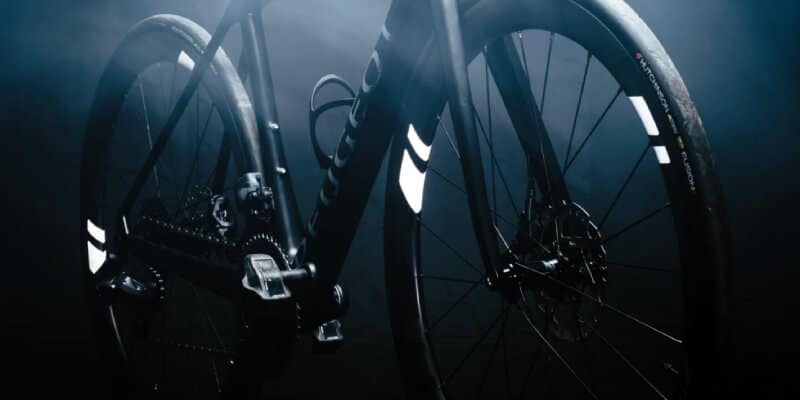
Final Verdict
The Beam Wheel Flash 2.0 is a brilliant, no-nonsense cycling safety product. For $24.95, you get a permanent, zero-maintenance upgrade that makes you visible from 500 feet in all directions. It is one of the best value-for-money safety accessories any cyclist can buy, and we highly recommend it.
No. Wheel Flash 2.0 reflectors are completely passive — they use retro-reflective glass powder pigment to reflect incoming light from car headlights and street lamps. There are no batteries, no charging, and no electronics involved.
Drivers can see the reflectors from approximately 500 feet (150 meters) away when headlights hit them. The retro-reflective material actually appears brighter at greater distances, making them highly effective for early detection.
No. The reflectors use 3M adhesive that can be removed without leaving residue or damaging your rims. However, the adhesive is very strong, so the reflectors themselves may be damaged if you try to peel them off and reposition them.
Wheel Flash 2.0 works on all rim types including carbon, aluminum, and steel. They are compatible with any brake type as well. Some riders with 29-inch or larger rims may need to trim the stickers slightly for a perfect fit.
The reflectors are designed to last for years. The 3M adhesive keeps them securely attached through rain, snow, and regular riding conditions. Since there are no electronics or moving parts, there is nothing to wear out or replace.
In most US states and many countries, bikes must have reflectors when ridden at night. Laws typically require a front white light, rear red reflector or light, and pedal or wheel reflectors. Wheel Flash 2.0 helps satisfy lateral visibility requirements while looking much better than standard plastic spoke reflectors.
Wheel Flash 2.0 is thinner, lighter, and more aerodynamic than traditional plastic spoke reflectors. Standard spoke reflectors only reflect from narrow angles, while Wheel Flash covers the entire rim for true 360-degree visibility. They also look significantly better and do not rattle or affect wheel balance.

Robert DeWitt writes about off-grid power gear for Off Grid Power Boom. Based in Arizona, he uses portable power stations, solar panels, and battery systems regularly in extreme heat—focusing on practical runtime, charging speed, reliability, and real-world usability for camping, RV trips, and home backup.
Editorial focus: portable power stations & solar generators, solar panel setups, batteries/inverters, and off-grid preparedness.